
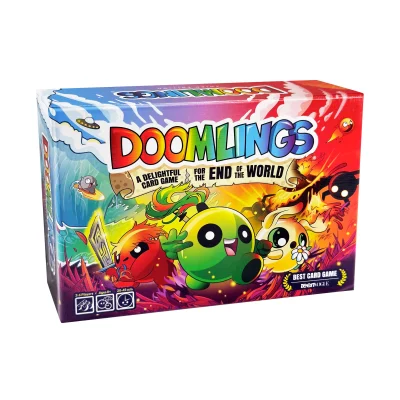
Doomlings Third Edition review

The end of the world is coming? At least it’s super cute.

Doomlings is a cute collectible card game about creating species, and out-performing your opponents in point scores. It’s been around for a few years now, inhabiting the middle ground between cartoony take-that card games like Exploding Kittens (shudder) and meaty-but-take-themselves-a-bit-too-seriously franchises like Magic the Gathering or Yu-Gi-Oh!
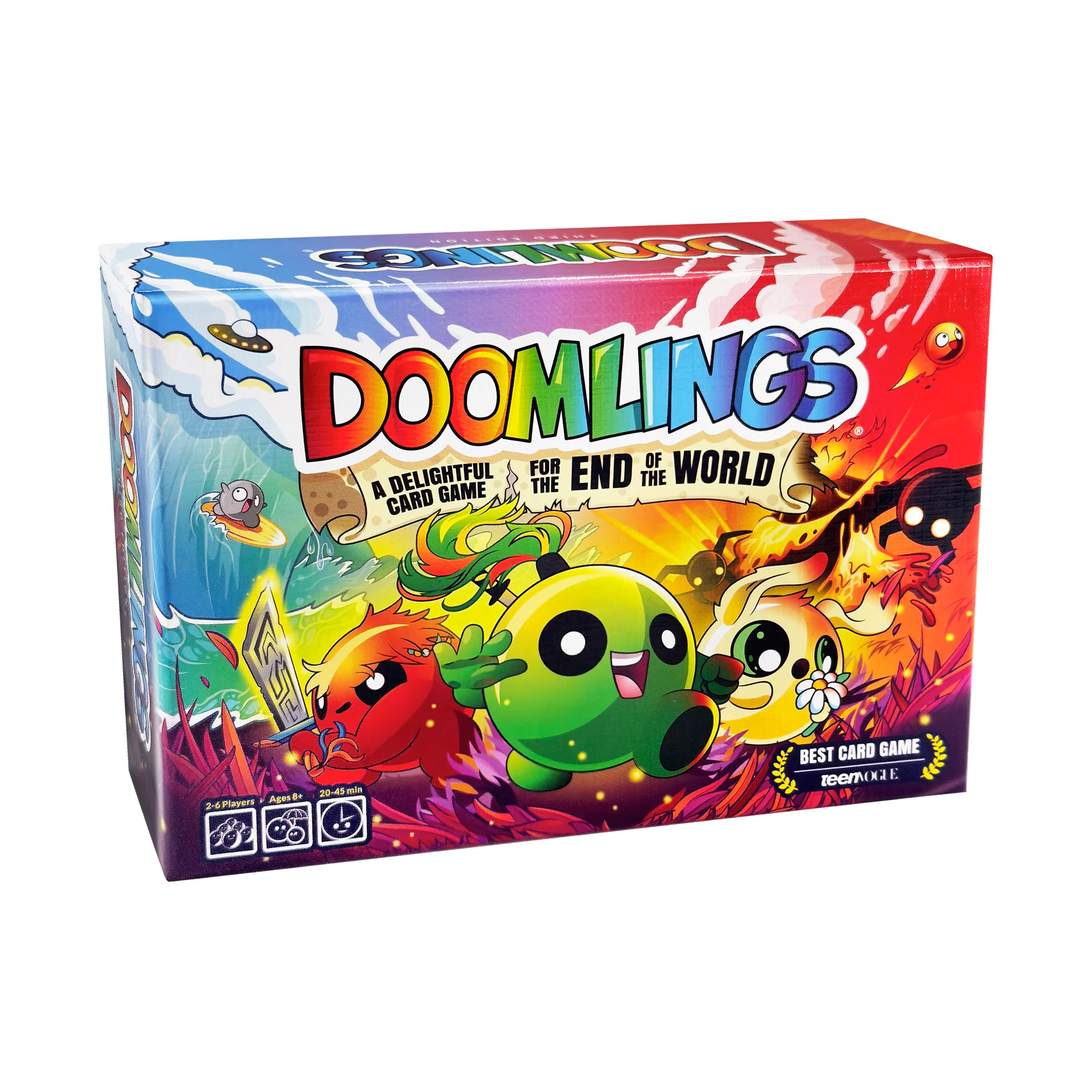
Expansion packs are available in a similar format to the classic LCG model by Fantasy Flight Games; you get everything in a set box without having to buy blister packs, even if there are some limited edition shiny cards available. There’s also a growing competitive scene, albeit one that’s pretty US based currently. I’ve become, almost inadvertently, the in-house Doomlings expert for TTG—I think this is my fourth review from the series.

Land vs Sea: Uncharted review

Two-edged territorial tussles with more points than ever

Land vs Sea is one of my favourite ever two-player games. It’s a fast and free-form alternative to two player Carcassonne, and achieves exactly what it claims to on the tin. Whilst the in-box expansions to the core game add a little complexity, each sits pretty firmly in the camp of “carefully arrange more symbols in the most optimal way”. What Uncharted brings are several new mechanics with a pretty impressive range of new mini expansions, with something for casual players all the way up to the extremely competitive.

The basic concept of Land vs Sea is that one player is Land, the other Sea (hence the name), and they take it in turns to place hexagonal tiles to

Pico review

Tiny things in a big package

Pico is a tabletop roleplaying game where the players become teenie-tiny bugs. It’s always refreshing to pick up something that’s not the tired old elves-dwarves-dragon stuff, and Felix Isaacs can always be relied on to break the mould in new and interesting ways. Pico is built on the same system as the incredible The Wildsea, so I was intrigued to see ways the system has been tweaked.

All characters in Pico are bugs in a huge world, and there are no humans left. It’s post-apocalyptic (although we don’t actually know why or what happened to the world, and almost all other creatures are dangerous, although bug-characters will be riding around on specially trained “picotitans”—dogs, cats, moles, etc, kitted

Mythic Baths review

Family-friendly fiend freshening

I have two pet dogs at home. Somehow, they have the ability to sort of absorb dirt, like weird, scratchy sponges, and then they vigorously shake their fur to scatter it liberally around my house. I’ve never seriously considered how much worse the mythical Cerberus would be at ruining household cleanliness, but as a three headed dog of legend, I’m confident it that hackle-shake would bring with it triple the damage. Bear with me on this odd intro, because Mythic Baths is a game of cleansing various chimerical beasts, and earning points for doing so. It’s a cute little game with an oddly specific theme that nevertheless works rather well.

To play, the table sets up a number of

Scales of Fate review

I cast thee into the Abyss—or do I cast myself?

Veiled Fate was a bit of a smash hit when it came out, a blend of social deduction and strategy, something like the love child of Blood on the Clocktower and Blood Rage. In the same universe comes Scales of Fate, using a familiar pantheon but replacing the multiplayer approach with a strictly two player duel

Players are assigned two secret demigod cards at the beginning of the game, and participate in a head-to-head battle of deduction, attempting to do two things; work out the identity of their opponent’s demigods and to position their own demigods in ways that score them points without giving away their identity.

Cube Express review

All aboard the cube train!

I’ve been playing board games for a very long time now, long enough that I remember when most games were sectioned into two genres; “Euros” and “Ameritrash”. The former were very beige, quite abstract, and often used simple rules and tokens to build quite complicated systems; the latter were detailed, thematic and often more simulationist than strategic. The hobby has moved on and become more nuanced since then, but Cube Express took me back around fifteen years; I’m not sure I’ve ever held a more “Euro-ey” game than this.

That might seem like criticism, but its not: let me explain. Cube Express involves 2-4 players building a small train network, trying to collect points in a variety of ways.

One for Sorrow review

A bird in the hand…

There’s an old nursery rhyme about magpies and superstition. There are many variants, but the most common goes “One for sorrow, Two for joy, Three for a girl, Four for a boy…”, and was used to predict fortune and favour—as well as potential future child gender, apparently.

One For Sorrow the game lightly retreads the theme here, adding all the numbers to reach the even more spine-curdling heights of thirteen—”Thirteen beware, it’s the devil himself”. The aim is simple; rearrange the birds in number order before the Spectre of Sorrows can destroy the forest (and, if the rhyme is to be believed, possibly before birds can definitively impact on embryonic sex chromosomes, although the rulebook doesn’t cover that).

QOMET review

Squaring up agains

I love abstract games. Don’t get me wrong, I enjoy a game with a beautiful engaging theme too, but there’s something about a geometric board and some simple, purely strategic gameplay that gets me going. Now, theres many classic games in this category, such as Draughts, Go and Chess, but amongst the newer titles in the field, Gigamic have made a real name for themselves with their Q range; Quorridor, Quarto, Quwale and several others. Qomet is their newest entry, another 15 minute tactical puzzler for two players.

The board consists of three concentric squares, each with a placement point at the corner and at the central point. It’s a design that will feel immediately familiar to any fans

Mimic review

I know where we are. Do you?

Mimic is a social deduction game about locations and hidden identity. One player is a Mimic, trying to hide in an unknown place, pretending to be there whilst the other players try to hunt them down.

To start with, every player is given a location card. The locations are places like “Mountain” or “Circus”, and every player except one will receive the same one. That one player, randomly and secretly, gets a card that simply says “Mimic”; thus they alone don’t actually know where the group is currently located.

Fluff n’ Fury review

Super cute murder machines

It’s a well publicised theory that after the apocalypse only one type of scuzzy, unappealing creatures that survive. Conventional wisdom says those lone survivors will be cockroaches, but Fluff n’ Fury is founded on a different premise: the future belongs to militarized fluffy toys.

Fluff n’ Fury is set in a tongue-in-cheek alternate reality where players become Furbies with flamethrowers. It’s built on an appropriate hacked version of the Year Zero system, as seen in Tales From The Loop and Alien RPG. It’s very well done; I initially thought it was actually a dice pool variant of MÖRK BORG, similar to FOUR BORG, partly due to the vibe and partly the nice rules summary in the inside cover. I